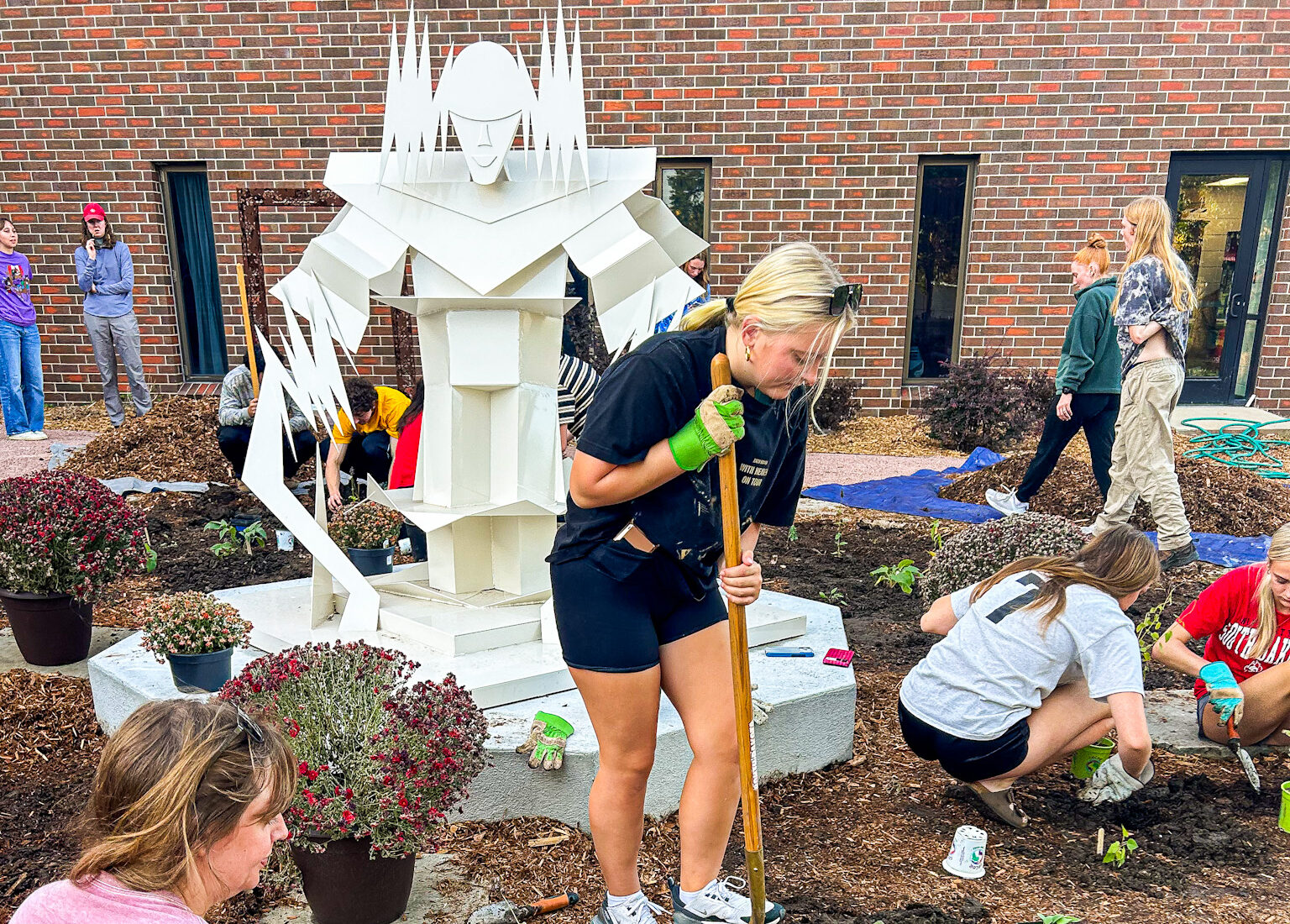
Planting the “Victorious” garden
After more than a year of hard work and preparation, the College of Fine Arts sculpture garden is now filled with native prairie plants.
USD’s Environmental Club and American Indian Science and Engineering Society (AISES) partnered with students from across campus to restore the landscape through their Planting the Prairie event.
This project began last September, when members of the clubs gathered to wash seeds harvested from prairie remanence. They continued hosting activities throughout the year to prepare the seeds for planting. By October of this year, the plants were ready to be placed in the garden.
These native plants frame the garden’s central sculpture named, “Victorious.” The sculpture was created by Colleen Cutschall, an Oglala-Sicangu Lakota artist, and was inspired by Oscar Howe’s “Woman Scalp Dancer”.
“It was very influential to see indigenous plants being planted here with the sculpture that was [created] by an indigenous artist,” Jade Ecoffey, vice president of AISES, said.
Ecoffey also discussed the garden being renamed “Ohiye”, the Lakota word for “victorious”, in Cutschall’s honor.
Ellie Goetzinger, president of the Environmental Club, said the plants illustrate the sculpture’s name.
“We always say that all the plants kind of represent and embody that really well because they’re victorious and resilient; they come back year after year and survive through harsh winters,” Goetzinger said.
Resilience is a central theme of the Planting the Prairie project. Because the plants are native to the area, they are better equipped to handle the local climate. They also require less maintenance than the non-native plants on campus, which reduces the workload for faculty.
This restoration initiative was completed as a result of community effort. The event, held Oct. 7, was originally scheduled for three hours. However, because of the large turnout, all the work was done in about an hour.
Goetzinger and Environmental Club Vice President Eliza Wilgers said their favorite parts of the project involved working with different organizations to make the event possible.
“Seeing other people also get excited about the same things is really great,” Wilgers said. “I just think this entire project has brought the community together in so many different aspects.”
Wilgers also said the event allowed participants to learn from one another.
The project provided education about the plants’ history and meaning, as well as the process of harvesting seeds and growing them into plants. The organizations hope the event will become an ongoing effort rather than a one-time project.
In the future, they hope to bring more native plants to the USD campus and the Vermillion community to “make [campus] look like a beautiful space,” Ecoffey said.

Related Posts
2026 midterm election results
TitleIX comments on ‘Cornell7’ incident