President Gestring retires after 9 years
On Oct. 14, the University of South Dakota’s President’s Office made an announcement on behalf of President Sheila K. Gestring stating that she will soon be retiring from the university. President Gestring has been the standing president for the past nine years, a position that she will be handing over at the end of the 2026 through 2027 academic year.
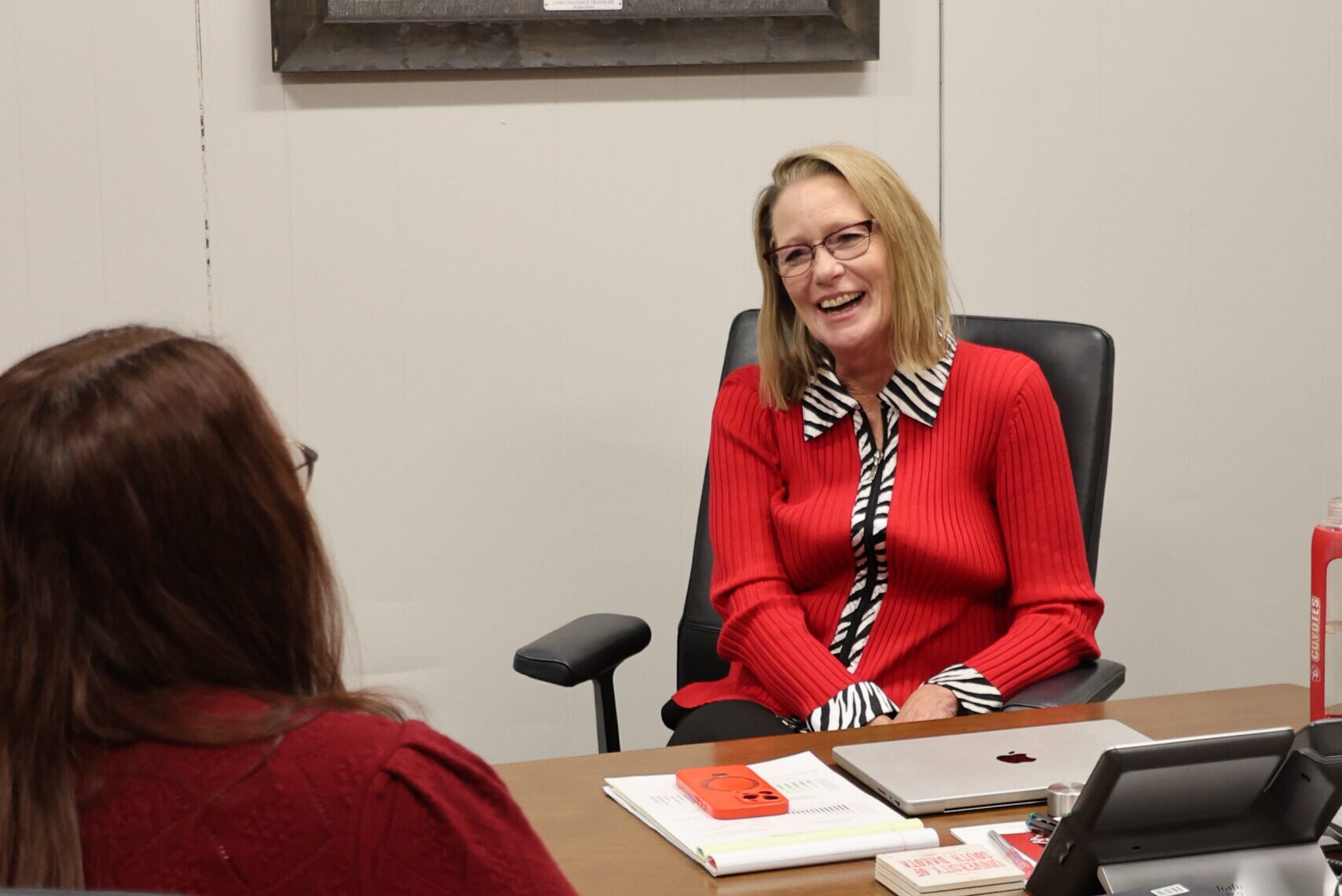
With her time at the University coming to an end, The Volante sat down with President Gestring to reflect on her time as president.
When looking back on your time at USD, what would you say has been your greatest accomplishment as president?
“I don’t think there’s a single building or program or anything that I would consider a greatest accomplishment. I would like to think it’s helping position the University of South Dakota for long-term success.We’ve created an environment where students are able to thrive and get a sense of belonging. I hope that’s what individuals would look to as some of the greatest achievements in my time here, and certainly that was not one person that did that. That was the entire campus: faculty, staff, students, donors, alumni, friends, lawmakers, and on and on.”
What was the biggest challenge that you have faced while taking on the role of president of USD?
“Without question, it was COVID. Right. We all had incomplete answers, and we were trying to make decisions for the health and well-being of our students and in our campus community, and our faculty and staff, and trying to navigate that so that we still provided the the best possible experience and kept everyone healthy at at the same time, without complete answers, and trying to navigate that.”
If you could go back in time, is there anything from during your presidency that you would change? If so, what would that be, and why?
“I suppose you could always find a few things where, with the benefit of hindsight, you might have approached something different, but I think overall, you can always look back and think maybe more communication or earlier engagement might have been better in certain circumstances. Because I found that people really do want to understand how you approach a decision and why you approach a decision, and just maybe overall more and earlier communication.”
What motivated you to pursue a career in higher education? How has that motivation changed since taking on the role of president?
“I had started in state government, and an opening popped up at the Board of Regents, and I thought higher education really is an opportunity to participate in a profession that really changes people’s lives and trajectories for the better. And I just really wanted to be a part of that, and it ‘s been the best decision of my life.”
Before taking on this position, had you ever imagined yourself being in a role such as this? If so, has your time as president fulfilled those expectations and how?
“I never anticipated being president of the university. No, I had actually thought I’d probably retire in the finance field within higher education, but becoming president was the honor of my professional career, and it has more than fulfilled everything I expected it might be.”
Is there a specific moment or achievement from your time as president that while may not appear in an annual report means a great deal to you personally?
“Several moments that would never appear in a report, but those moments interacting with students, where they might say something like, ‘You know, I’m really glad that you challenged me to step outside my comfort zone, or I’m really glad we got to know each other, or this piece of advice really helped me.’ An email recently that I received from a student was incredibly thoughtful, and it just reminds me of how brilliant and thoughtful our students are overall, all the time. Those are the moments that are really special to me.”
What do you hope will be remembered by students and faculty members alike regarding your time at USD? Is there a specific legacy you would like to leave behind?
“Not a specific legacy in particular. I imagine that those that are that remain get to define what that legacy is. The person leaving probably doesn’t, but I hope that people will remember that I care deeply about the university and its people, and approached every decision with the long-term interests of the institution in mind.”
What are some of the aspects of USD’s culture or identity that you hope stay the same long after your retirement?
“I hope the university always stays student-centered. I think that’s critically important to our identity and has served the university very, very well.”
How did you know that it was the right time for you to step back from your role as president? What do you hope to gain from retirement?
“There are a lot of things that go into making that decision, but I think leadership transitions can be really healthy. And I felt that the university is so well positioned right now that it’s a perfect time to let the next generation of leaders build on the momentum. And as for stepping away from this particular opportunity, it allows me to step towards a new opportunity and spend more time with family. I don’t think I’ll ever regret making the decision to spend more time with my family.”
What preparations are underway or in discussion to help the transition in leadership go smoothly?
“Working with the Board of Regents to make sure that they’re talking with campus to hear what campus would like to see in the next leader, putting together a leadership profile. They’ll be here in the next few weeks, and then they’ll start advertising, asking for nominations for individuals to serve on the search committee. I’m putting together a leadership sort of transition document for that individual, so that the handoff can be very smooth in that way.”
Do you plan to stay connected to the university or the Vermillion community after your retirement?
“Absolutely, yes. My husband and I, we’ve been here for 20 years. We raised our boys here. We have a wonderful home on the river, just a few miles from here, and all of our friends are here. So we’ll be cheering for the oats and supporting USD just in a different capacity, and we’ll always be connected to the university and committed to USD.”
What is the biggest lesson that being in this role has taught you?
“The biggest lesson, I think, it goes back to that communication, and you can never over communicate, and doing it early and often, and making sure that people are part of the process, and appreciating all of that input, because sometimes you might think, ‘oh, I don’t want to bother people with that, but it’s not a bother.’ People are eager to participate, and that’s wonderful that our campus is that eager.”
Photo credit: Vivica Kruel

Related Posts
TitleIX comments on ‘Cornell7’ incident
The 2026 midterm elections: The local voting impact