USD Office of Accessibility Hosts First Accessibility Walk
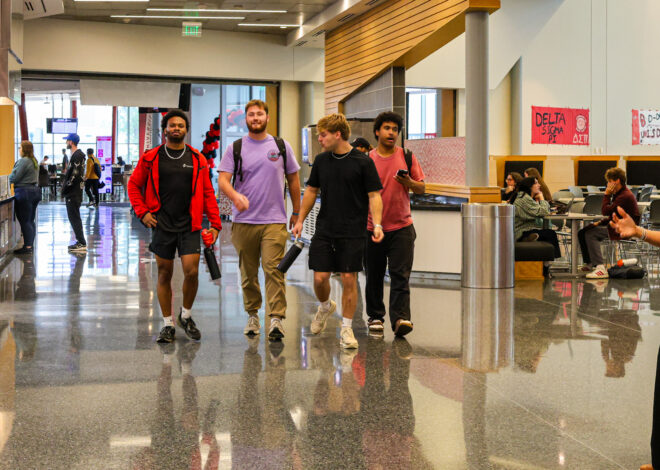
On Feb. 19, the Office of Accessibility hosted their first Accessibility Walk. The group started at the coyote statue, then walked towards Patterson Hall, then back to the Office of Accessibility in the library.
Their goal was to point out any faults of the different accessibility options at USD and make them known. There was also an open house at the Office of Accessibility office, which handed out free walking tacos to the first 50 people and discussed more about the club.
Olivia Allen is the president of USD Student Access. She was the first co-president of the new Office of Accessibility, which started in the beginning of 2023.
“The accessibility walk is important because we’re able to put ourselves in someone else’s shoes, which I feel like is a thing students don’t often think about going to and from class, how someone in a wheelchair is navigating through life,” Allen said.
The accessibility walk isn’t just a way to bring attention to the ways USD can improve on accessibility optionsThe walk is a way for the Office of Accessibility and Student Access to be more known and gain notoriety in the university.
“The Office of Accessibility just really bridges the gap for students,” Allen said. “We specialize in accommodations coordinators, and it’s not all physical disabilities like accessibility buttons. The Office of Accessibility works closely with digital accessible areas as well.”
The Office of Accessibility replaced the previously known Center for Disabilities after its owner stepped down. Dr. Angela Jackson assumed the role of director and that’s when the name changed to the Office of Accessibility. Allen stated that the role of the Office of Accessibility is to advocate for independence of setting up accommodations, but also to make the process as safe and as easy as possible.
“I think the Office of Accessibility is a safe place for students to not be afraid to ask for help,” Allen said.
Allen is also creating a program called the Empower Ambassador Program that allows those seeking accommodation to talk to a student instead of a director or doctor to make it easier for them.
The Office of Accessibility is also there for those that have mental disabilities, such as ADHD or depression. Kat Boeding, a senior at USD, talked more about the process of gaining accommodations.
“I use my accommodations on exams, usually ones that require more time per person like math, language or ones with essay questions,” Boeding said.
Boeing also mentioned that the Office of Accessibility is important.
“It’s really helpful and it’s only right that people complete their work with all of the resources they need to be successful,” Boeing said.
For more information, visit the Office of Accessibility in the I.D. Weeks library room 102B or contact the office by email at accessibility@usd.edu.

Related Posts
Yotes fall in rivalry match aginst SDSU
USD faces off against the the big dogs